
A solid Starlight Princess strategy isn’t about beating the random number generator — no legitimate approach to a licensed slot can do that. It’s about managing bankroll, bet size, and session pacing in a way that accounts for the game’s high volatility and its multiplier orb system, which only becomes active during free spins and rewards long tumble chains far more than any single large cluster. This guide walks through every practical component of a well-structured Starlight Princess strategy, from bankroll allocation to session tracking, with the reasoning behind each recommendation.
Understanding the Multiplier Orb Before Building a Starlight Princess Strategy
Before any bankroll or betting plan makes sense, it helps to understand what actually drives variance in this specific game. Unlike cluster pays titles where a multiplier is tied to a symbol that can appear at any point in the base game, the Starlight Princess slot’s multiplier orb activates specifically during free spins and grows with every consecutive tumble in a winning sequence. A Starlight Princess strategy has to account for this free-spins-only structure directly, since it means the base game and bonus round should be approached with different expectations entirely.
Why the Base Game and Free Spins Require Different Mindsets
Because the orb multiplier is exclusive to the free spins feature, a Starlight Princess strategy should treat the base game primarily as a path toward triggering that feature rather than a source of standalone large wins. This reframes bet sizing decisions around sustaining enough spins to reach free spins reliably, rather than optimizing purely for base-game payout frequency.

1xBet
🎁 Up to +500% bonus on first deposit
🎰 +250 free spins
📈 High odds on sports
💸 Fast payouts and cashback

MelBet Casino
🎁 Welcome package up to ₽150,000
🎰 Up to +290 FS on top slots
💸 Cashback and bonuses on repeat deposits
⚡️ Fast games, crash and live casino

1xSlots
🎁 100% up to €150 on deposit
🎰 Up to 100 FS on slots
💸 Up to 10% cashback
🔥 VIP tier + tournaments

MostBet Casino
🎁 Up to +100%–250% bonus
🎰 Up to 250 FS
💰 Deposit bonus
💸 Up to 10% cashback
How a Starlight Princess Strategy Should Handle a Long Base-Game Stretch
Because the multiplier orb is exclusive to free spins, an extended base-game stretch without a trigger can start to feel unproductive, even though it’s a statistically normal part of how this game’s variance works. The temptation in these stretches is usually to either speed up play or start second-guessing the bet size, neither of which changes the underlying odds of a scatter symbol landing.
A more useful response is to treat a long base-game stretch as confirmation that the plan is working as intended — spins are being spent within budget, waiting for a trigger — rather than as a sign that something needs to change. The goal during this phase isn’t to force an outcome, but simply to stay within the pre-set session boundaries until either free spins trigger or the session naturally reaches its planned end.
Bankroll Management Principles for Starlight Princess Strategy
Bankroll management is the foundation of any Starlight Princess strategy, since the game’s high volatility means winning stretches and dry stretches can both run longer than expected, particularly given that the multiplier orb only comes into play once free spins are triggered. A widely used guideline is to risk no more than 5% of a total bankroll in any single session, which allows enough spins to reach a meaningful sample size without exposing the full budget to one unlucky run.
Bankroll Allocation by Budget Size
The table below illustrates how this 5% guideline translates across different overall bankroll sizes, along with the approximate number of spins that allocation typically supports at a proportionally scaled bet.
| Total Bankroll | Recommended Session Budget (5%) | Approximate Spin Count |
|---|---|---|
| $50 | $2.50 | 100–150 spins |
| $100 | $5.00 | 100–150 spins |
| $250 | $12.50 | 100–150 spins |
| $500 | $25.00 | 100–150 spins |
A larger bankroll under this approach doesn’t translate into more spins — it translates into a proportionally higher bet size while keeping session structure the same, which keeps the relationship between bankroll and session risk consistent regardless of budget.
Bet Sizing: A Step-by-Step Approach
Choosing a bet size is one of the more consequential decisions in any Starlight Princess strategy, since it directly determines how meaningful an escalating orb multiplier would actually be if a strong free spins round is reached. The following sequence outlines a practical way to settle on a starting bet:
- Calculate the session budget as roughly 5% of the total bankroll set aside for play.
- Divide that session budget by a target spin count of at least 100, to establish a baseline maximum bet per spin.
- Start the session at or slightly below that baseline bet to leave room for adjustment.
- If scatter symbols begin appearing with noticeable frequency, consider maintaining rather than reducing bet size heading into a likely free spins trigger.
- If the session produces a long stretch without free spins triggering, resist the urge to increase bet size in an attempt to force the feature.
This structure keeps bet sizing tied to a defined process rather than an emotional reaction to recent spins, which matters especially in a title where the biggest payout potential is concentrated almost entirely within one specific feature.
Why Bet Consistency Matters More Than Bet Optimization
Players often search for an “optimal” bet size as though there’s a single correct number waiting to be discovered through enough trial and error. In practice, for a game where variance is this high, consistency in applying a reasonable bet size matters far more than fine-tuning that number to some theoretically perfect value, since no amount of optimization changes the fundamental randomness of when free spins will trigger.
This reframing can reduce a lot of unnecessary second-guessing during a session. Rather than treating bet size as a variable to constantly adjust in search of better results, it’s more productive to settle on a reasonable figure within the recommended range and then focus attention on the parts of a plan that actually are within a player’s control — session length, stop-loss discipline, and logging outcomes.
Multiplier Orb Timing Tactics Within a Starlight Princess Strategy
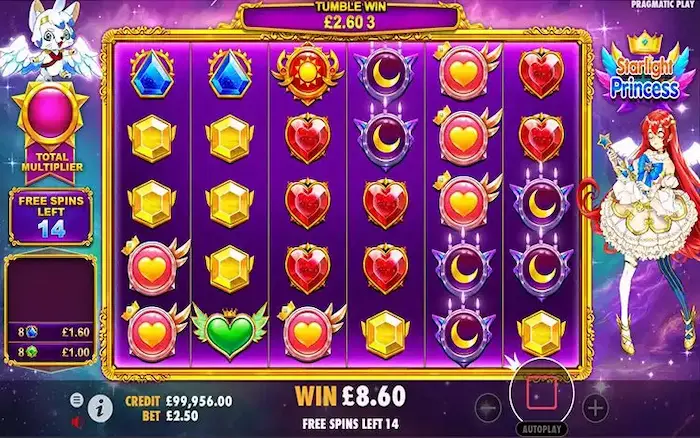
Once free spins are triggered, the multiplier orb becomes the single biggest swing factor in this game’s payout potential, and while its growth depends on random tumble outcomes, there are still tactical considerations worth building into a Starlight Princess strategy around how to approach the round as it develops:
- Confirm the bet size before free spins begin, since it locks in for the entire round and directly determines how valuable the accumulating orb multiplier will be in real terms.
- Treat an early tumble within free spins as a neutral signal rather than a reason to expect the round will necessarily run long, since chain length isn’t predictable from its first few steps.
- Track how the orb’s displayed value changes with each tumble, since watching its growth in real time helps gauge how significant a given round is becoming.
- Remember that the orb resets between separate triggers of the free spins feature, so an exceptional previous round has no bearing on how the next one will unfold.
None of these tactics change the underlying odds, but they help ensure that once free spins are reached, the bet size already locked in is one that makes the resulting multiplier meaningful rather than incidental.
Session Planning and Time Limits
Because the Starlight Princess slot can produce long stretches without triggering free spins, session length needs to be planned with the same discipline as bankroll. Sessions capped between 30 and 40 minutes are generally recommended, giving enough time to evaluate the game’s behavior without extending exposure during an extended dry period.
Recommended Session Length by Bet Level
| Bet Level | Recommended Session Length | Session Character |
|---|---|---|
| Low | 45–60 minutes | Extended, steady pacing |
| Medium | 30–40 minutes | Balanced risk and duration |
| High | 15–20 minutes | Short, high variance |
Using an external timer — a phone alarm or a browser extension — removes the guesswork of tracking elapsed time manually, which matters more than it sounds during a session where anticipation of triggering free spins can make minutes pass unnoticed.
A Starlight Princess Strategy for Players New to Feature-Concentrated Slots
Players coming from titles where payout potential is spread more evenly across base game and bonus features sometimes find the adjustment to a feature-concentrated game like this one counterintuitive at first. The instinct to expect meaningful wins during ordinary base-game play doesn’t map well onto a title built around funneling most of its upside into one specific round.
For players making this adjustment, it helps to mentally separate the two phases of the game from the outset — treating base-game spins as the cost of admission to a lottery-style event, and treating the free spins round itself as the actual game being played. This reframing tends to reduce the frustration that comes from judging base-game performance by standards that were never really designed to apply to it.
Stop-Loss and Take-Profit Rules
A stop-loss is a predefined point at which a session ends regardless of how the player feels in the moment, and a take-profit is the equivalent threshold on the winning side. Both are essential components of a disciplined Starlight Princess strategy, particularly because a strong free spins round with a high orb multiplier can create a false sense of momentum that leads to overplaying a session that should have already ended.
Setting Practical Stop-Loss and Take-Profit Levels
- Decide on a stop-loss amount before the session starts — commonly 100% of the session budget, meaning the session ends if that full amount is lost.
- Set a take-profit target, often between 2x and 3x the session budget, as the point at which the session ends regardless of how the game “feels.”
- Write both numbers down or set them as explicit reminders, since verbal intentions are easy to abandon mid-session.
- Once either threshold is hit, close the session — treat this as a non-negotiable rule rather than a suggestion.
- After a strong free spins result, consider setting aside a portion of it before continuing, so a subsequent losing stretch doesn’t erase the entire result.
These thresholds don’t need to be complicated to be effective — the value comes from deciding them in advance, before the excitement of watching the orb multiplier climb can influence the decision.
Free Spins Strategy Considerations
The free spins round is where the entirety of the Starlight Princess slot’s multiplier potential is concentrated, since the orb system doesn’t operate at all in the base game. A few tactical points are worth keeping in mind specifically for this feature:
- Understand that base-game spins primarily serve to accumulate scatter symbols rather than to produce standalone large wins, which should shape expectations for the base game portion of a session.
- If a feature buy option is available, treat it as a separate, clearly budgeted expense rather than drawing from the same funds allocated to base game spins.
- Avoid judging a single free spins round’s outcome as representative — variance within this feature is naturally high even across a large sample of triggers.
- Recognize that a short free spins round with limited tumbling is a common outcome and shouldn’t be treated as evidence the game is underperforming.
The Value of Reviewing a Session Log Immediately After Play, Not Days Later
The accuracy of a session log depends heavily on how soon after playing it gets filled in. Details like how a free spins round unfolded, whether bet sizing decisions felt rushed, or whether a stop-loss limit was nearly broken tend to blur quickly once a session ends, especially if several days pass before the log entry is made.
Filling in the log within minutes of ending a session — while the specifics are still fresh — produces a far more useful record than reconstructing details from memory later. This small habit shift, treating logging as part of the session’s closing routine rather than an occasional afterthought, tends to make the resulting data meaningfully more reliable over time.
Volatility-Adjusted Bankroll Planning
Because the Starlight Princess slot sits in the high volatility category, bankroll planning benefits from being adjusted relative to lower-volatility alternatives a player might be more used to. The table below compares recommended bankroll depth across volatility tiers, measured in number of minimum-bet spins a session should be able to sustain.
| Volatility Tier | Recommended Spin Depth | Bankroll Implication |
|---|---|---|
| Low volatility | 50–75 spins | Smaller reserve needed |
| Medium volatility | 75–100 spins | Moderate reserve needed |
| High volatility (Starlight Princess) | 100–150 spins | Larger reserve recommended |
This deeper spin depth requirement is one of the more overlooked aspects of a Starlight Princess strategy — players coming from lower-volatility titles often underestimate how much bankroll depth this game’s variance actually calls for, especially given how concentrated its payout potential is within the free spins feature specifically.
How a Starlight Princess Strategy Interacts With Multi-Game Sessions
Some players don’t dedicate an entire session to a single title, instead moving between several slots within the same sitting. This introduces a complication for bankroll tracking, since a stop-loss or take-profit figure set with this specific game in mind can get diluted or forgotten if attention shifts to a different title mid-session.
If multi-game sessions are part of a regular routine, it helps to treat each game switch as effectively starting a new sub-session with its own budget carved out in advance, rather than letting one shared pool of funds drift across multiple titles without clear boundaries. This keeps the discipline built around this specific game’s volatility from being unintentionally overridden by decisions made while playing something else entirely.
Feature Buy vs Natural Trigger: A Comparison
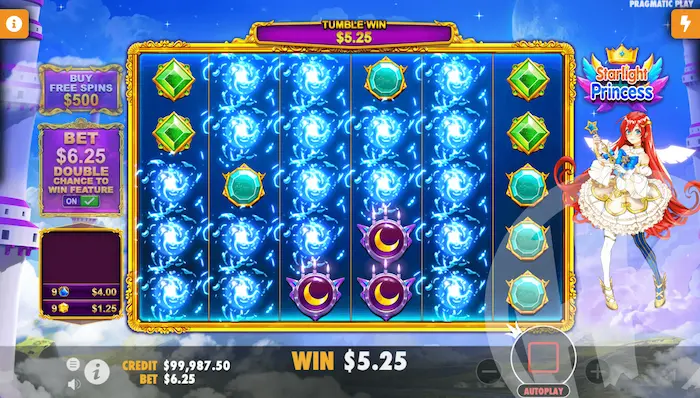
Some operators offer a feature buy option that lets a player pay a set fee to enter the free spins round directly, bypassing the need to land scatter symbols naturally. Deciding whether this fits into a given Starlight Princess strategy depends on session goals and bankroll depth.
| Approach | Cost Structure | Best Suited For |
|---|---|---|
| Natural trigger | Spread across base game spins | Longer sessions, steady bankroll use |
| Feature buy | Fixed upfront cost per entry | Shorter sessions, larger dedicated budget |
Feature buy access doesn’t change the underlying odds within the round itself, but it does concentrate risk into fewer, larger decisions rather than spreading it across many smaller ones — a distinction worth weighing carefully before including it as a regular part of a session plan.
Why Round Duration Varies So Much Once Free Spins Begin
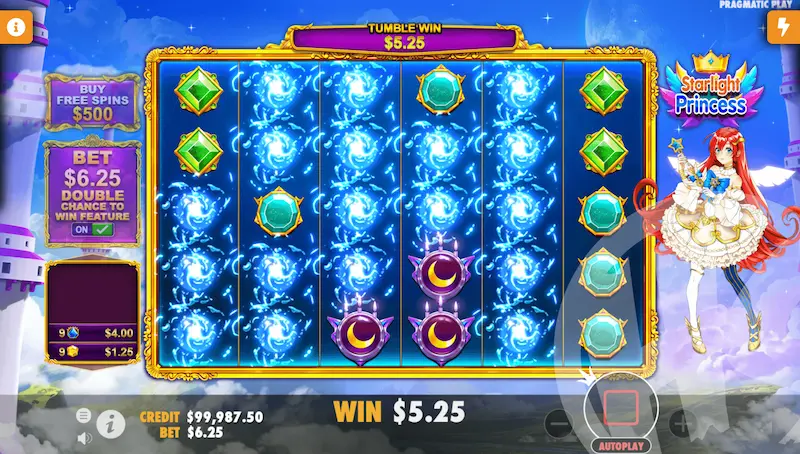
Once triggered, a free spins round can end after just a handful of spins with minimal tumbling, or it can extend considerably longer if tumble chains keep producing new clusters. This variability in duration is a direct consequence of how the orb system is built — there’s no fixed number of tumbles guaranteed, only a process that continues for as long as new matches keep forming.
This means the time commitment of a single free spins round is itself unpredictable, which is worth factoring into session time planning. A round that runs unexpectedly long can push a session past its intended time limit even if the player has no intention of extending play beyond that point, simply because the round itself hasn’t resolved yet.
Autoplay Precautions
Autoplay can be a convenient feature, but it removes the manual pacing that naturally slows down decision-making between spins. Within a disciplined Starlight Princess strategy, autoplay should be used cautiously:
- Set a stop-on-loss-limit and stop-on-win-limit before activating autoplay, since most platforms support these parameters directly.
- Avoid using autoplay during the first sessions with this game, since it’s easier to misjudge pacing before understanding how base-game spins relate to free spins frequency.
- Periodically check in on an autoplay session rather than letting it run fully unattended, particularly once a free spins round begins.
- Treat autoplay as a pacing tool, not a way to disengage from the session’s predefined stop-loss and take-profit rules.
Keeping a Session Log
Tracking outcomes over time turns a Starlight Princess strategy from a set of one-off decisions into a system that can actually be refined. A simple log doesn’t need to be complicated — the table below outlines the core fields worth recording after each session.
| Field | Purpose |
|---|---|
| Session date | Tracks frequency and spacing of play |
| Starting budget | Baseline for calculating session result |
| Bet size used | Correlates outcomes with bet level over time |
| Highest orb multiplier reached | Helps gauge how free spins rounds are performing over time |
| Result (win/loss amount) | Core data point for long-term evaluation |
Over several sessions, this kind of record reveals patterns that are difficult to notice in the moment — how often free spins actually trigger at a given bet size, and whether stop-loss or take-profit limits are actually being respected in practice.
Starlight Princess Slot: Complete Game Guide
The tumbling grid, multiplier orb mechanic, RTP, and volatility explained in full detail.
Read the Full Guide →A Starlight Princess Strategy Perspective on Loss Aversion
Loss aversion — the tendency to feel losses more intensely than equivalent gains — plays a particularly outsized role in a game where most sessions end in a modest net loss by design, punctuated occasionally by a much larger win. This asymmetry can make disciplined bankroll management feel emotionally harder than the math alone would suggest, since the frequent small losses register more strongly than their actual financial weight.
Recognizing this bias explicitly — rather than assuming a string of modest losses reflects something going wrong — helps separate a rational evaluation of session outcomes from an emotional one. A session that ends at the planned stop-loss isn’t a failure of strategy; it’s the plan functioning exactly as designed, even if it doesn’t feel that way in the moment.
Six Common Mistakes That Undermine a Starlight Princess Strategy
Even a well-planned approach can break down in execution. The following mistakes come up repeatedly among players applying strategy to high-volatility cluster pays slots with feature-exclusive multiplier systems:
- Increasing bet size after a losing stretch in an attempt to force free spins to trigger sooner.
- Expecting base-game spins to consistently produce large wins, when most of this game’s payout potential is concentrated in the free spins feature.
- Treating a single free spins round’s outcome as a meaningful sample rather than one data point among many.
- Skipping the demo mode entirely and learning the tumble and orb multiplier rhythm using real-money spins instead.
- Using autoplay without setting stop-on-loss or stop-on-win parameters beforehand.
- Continuing to play immediately after hitting the take-profit threshold, effectively erasing the discipline the limit was meant to enforce.
Most of these mistakes share a common thread — they involve abandoning a pre-set rule in response to in-the-moment emotion, which is precisely the scenario stop-loss, take-profit, and session limits are designed to prevent.
Adjusting a Starlight Princess Strategy When Playing on Mobile vs Desktop
Mechanically, mobile and desktop play produce identical odds, but the practical experience of executing a strategy can differ meaningfully between the two. Smaller mobile screens make it easier to lose track of session time or misjudge how long a free spins round has actually been running, simply due to reduced visual real estate for on-screen timers or reminders.
Players who primarily play on mobile may benefit from relying more heavily on external tools — a phone’s built-in timer or alarm rather than an in-game clock — to compensate for this reduced visibility. The underlying strategy doesn’t need to change between devices, but the tools used to enforce it may need slight adjustment depending on which platform a session takes place on.
Starlight Princess Strategy: Frequently Asked Questions
No, they’re the same bet, since whatever size is active when free spins triggers is the one that locks in for the whole round. Rather than treating base game and free spins as separate bet decisions, a Starlight Princess strategy should pick one consistent bet size that’s already appropriate for a strong free spins outcome before the session even starts.
Not really, since scatter frequency has no relationship to bet size. Lowering the bet during a dry base-game stretch only reduces how meaningful the eventual free spins round will be if it triggers, without improving the odds of it triggering any sooner.
There’s no strict minimum, but drawing conclusions from fewer than five or six triggers tends to be unreliable given how much variance exists within this feature. A session log becomes genuinely useful for spotting patterns once it covers enough sessions to include a reasonable number of free spins rounds, not just one or two standout results.
No. Each free spins round is an independent outcome, and a short round with a low multiplier has no bearing on how the next triggered round will play out. Treating a weak round as a signal that a strong one is “due” is a common reasoning error worth actively avoiding.
No. A feature buy only guarantees entry into the free spins round itself — once inside, the orb multiplier still grows based on the same random tumble outcomes as a naturally triggered round. The only thing that changes is how the round is accessed, not how it unfolds afterward.
The clearest sign is that the session actually ends the moment either threshold is reached, without a follow-up spin “just to see.” If a session log consistently shows the recorded result matching the pre-set limit exactly, that’s a strong indicator the rule is being respected rather than bent in the moment.
Psychological Discipline During High-Volatility Sessions
Long stretches without free spins triggering are a normal, expected part of playing a high-volatility title, not a sign that something is wrong with the game or that the feature is somehow “overdue.” Recognizing early signs of tilt — impulsively raising bets, chasing losses, or repeatedly telling yourself “just one more spin” — is one of the more valuable skills a Starlight Princess strategy can build over time. The moment any of these patterns appear, the most effective response is usually a short break rather than continued play.
Framing the game as entertainment rather than a source of guaranteed income also plays a meaningful role in maintaining discipline. This mindset doesn’t change the math behind the RNG or how the multiplier orb system operates, but it does change how a player responds emotionally to both winning and losing stretches, which in practice has a much larger effect on session outcomes than any specific betting tactic.




Starlight Princess Strategy: Summary
A sound Starlight Princess strategy rests on a handful of interconnected habits: allocating bankroll in proportion to the game’s high volatility, choosing a bet size deliberately rather than reactively, setting stop-loss and take-profit limits before a session begins, and tracking results over time to refine future decisions. None of these habits guarantee a winning outcome, since the underlying result of every spin remains governed by an independently certified random number generator. What they do provide is a structured, repeatable framework that keeps sessions controlled and intentional, even during the extended dry stretches that come with playing a high-volatility title where payout potential is concentrated in a single feature.
Players who haven’t yet reviewed how the underlying mechanics work — including the grid structure, symbol system, and multiplier orb this strategy is built around — can find a full technical breakdown in the main Starlight Princess slot guide.